Grandad, Are You Old? …

IMG_4479

One of my grandchildren, sitting on my lap some time ago, was staring at me before innocently asking, “Grandad, are you old?”

“Goodness, no,” I replied.  “I’m just an old timer.”

Which led me to think … Old Timers Game, Atlanta, 1975.  And, a prized possession, the picture of me and Joe DiMaggio together in a dugout at now demolished Fulton County Stadium.  Joe DiMaggio, popularly known as Joltin’ Joe and The Yankee Clipper.  The picture (above), neatly framed by my WW, sits on a shelf in a corner of my office; I call it my ego corner.  That’s me on the left, replete with hair over my ears, extending a pen and baseball for DiMaggio to autograph.  The camera also caught DiMaggio’s trademark tip of his hat.  A sports writer from Sumter, S.C., snapped the picture and mailed it to me weeks later.  I did not know he took it, and I could not thank him enough.

The 1975 Old Timers Game featured a lot of former baseball stars.  They were “former” even back in 1975.  Most have dozed off and woke up in heaven, as I would tell my grandkids.

Joe DiMaggio, Red Schoendienst, Pee Wee Reese, Hoyt Wilhelm, Larry Doby, Ralph Branca, Luke Appling, Johnny Vander Meer – they were all there.  They are all together today, probably playing catch in baseball heaven.  With them upstairs is Bill Skowron, Ken Boyer, Bob Turley, Tito Francona and several others who played in that three-inning game 43 years ago.  I know of only two who are still awake here on earth – Bill Mazeroski and Bobby Richardson.

Being on the field with these greats – prior to the actual game, of course – was unforgettable. This might be boring stuff unless you are a baseball buff.  If you are into baseball, you might know that Pittsburgh’s Mazeroski hit a home run in the bottom of the ninth inning in the 1960 World Series to beat the Yankees (and Richardson).  And, Richardson – from Sumter and a former University of South Carolina baseball coach – set a major league record with six runs batted in against the Pirates in one game in that same World Series.  That record still stands although it has been tied by two other players.

The other Old Timers were quite distinguished, too, probably more so.  DiMaggio, of course, had at least one hit in 56 consecutive games, a record that still stands in the major leagues.  Most baseball experts say that record never will be broken.  Pitcher Vander Meer had back-to-back no-hitters for the Cincinnati Reds, a feat never equaled.  Ken Boyer had a grand slam in the 1964 World Series that highlighted the Cardinals’ series win over the Yankees.  And, so on … if they had not accomplished something truly remarkable, they would not have been honored as an Old Timer that day.

It was Richardson who was the star among stars in the 1975 Old Timers Game, not that it mattered.  My much faded play-by-play notes, now 43 years old, show that he opened the game with a single on the first pitch, stole second and later scored.  He also scored after a double in the third inning and his team won the abbreviated game 3-1.  And, that didn’t matter either.

What mattered was baseball fans had a chance to see some of the all-time greats of the game.  Most are no longer are here, and memories of them have faded, but the Old Timers enjoyed being there for their fans in the twilight of their lives.

I know because it takes an Old Timer to know an Old Timer.


Aunt Anna At 100 …

For a hundred years, everybody has loved Aunt Anna.

Just not all the time.

The oldest of eight sisters, she has outlasted all but two.  Only her brother was born before her, and Costa passed away years ago.  Can you imagine being Costa with eight Greek sisters in the house, competing for bathroom use or looking for quiet time?

But this isn’t about Costa, a dear uncle who invented patience.  It’s about Aunt Anna, the first of eight Rousso girls who grew up mostly on Rutledge Avenue in Charleston before marrying Jimmy Friend and having two children, Pee Wee and Ellen.  Pee Wee was a boyhood hero of mine because he was a darn good baseball player, “damn good” if you ask Aunt Anna.  Ellen was smart and sweet; probably inherited the intelligence from her Mom but not the sweetness.  As cousins were known to say, certainly not within earshot of their aunt, “Aunt Anna can be mean.”  Actually, she didn’t really care what you said.

But, I never considered Aunt Anna to be mean.  Even when we would visit her in her pristine house as a youngster.  My mother would warn us, “Don’t touch a thing when you go inside,” and we knew to obey.  Aunt Anna invented the word pristine right after the word immaculate.  I once commented how nice a trinket looked; “Don’t touch it,” she barked with a frown.  And I didn’t dare.

If you were brave enough to touch one of her hundreds of trinkets, or even if you moved too close to one, you could risk admonishment that you’d never forget.  And, that look, that stern look.  My mother would always tell us, “just sit there on the couch and don’t move.”

But, again, I never considered Aunt Anna to be mean.  Every time she worked me over with that frown and stern look, I kept looking at her until I saw the slight smile.  That was the giveaway.

She has outlived Jimmy Friend, two children, second husband Bill Utsey, as well as five sisters, her brother and plenty of nieces and nephews.  She has never been on an elevator, probably doesn’t trust them, and has lived long enough for her doctor to come to her house rather than the other way around.  She likely gave him an ultimatum.  During the most recent hurricanes to come through Charleston, she stayed put.  Asking her to leave was a waste of breath; insisting she leave would get you a death threat.  And her yard today, even after hurricane battering, is like her house of trinkets 80 years ago.  Spotless.  You don’t want to be her gardener.

But beneath that stern look, if you look closely … really, that hint of a slight smile.  Aunt Anna’s frown, most times anyway, was followed by that smile that she tried hard to keep out of sight.  She had a reputation to live up to and she was good at it.  Still is.

At her 100th birthday celebration, which she did not want to have, everybody showed up.  Nobody touched a trinket, but everybody showed up.

For a hundred years, everybody has loved Aunt Anna.

Three Really Bad Words …

Trey and I have had quite a few confidential conversations, me the Grandad and him a Grandson.  Just the two of us.

A lot of those chats have been at The Cabin, some in a boat, others riding in a vehicle.  Of course, what happens at The Cabin stays at the cabin, and that applies to boats and vehicles as well.  But there is a ten-year rule that I forgot to mention to Trey.  After 10 years, anything goes.

So, Trey turned 16 this year.  When he was six – maybe five – we were talking about nothing in particular when the subject of bad words came up.  We were sitting in the den of my Roswell home, and his parents were in another room.  Surprisingly, he told me that he knew three bad words.  No telling what he had heard at school, on the bus or wherever.  I was very curious.

“What are they?”  I asked him.

“No way, Grandad,” he said. “I can’t tell you.”

“Why?” I asked.

“My Dad told me to never say those three words,” he said. “So I cannot say them.”

My curiosity was getting the best of me.  Plus, I was bracing for some pretty rough language.

“Just whisper them to me,” I told him.

“No way, Grandad.  They are really bad words, and I’m not suppose to say them.”

I told him okay and that I was proud of him for not saying bad words and for listening to his parents.

Then Trey had a suggestion.  “Maybe if we went in the basement nobody would hear me,” he said, adding, “let’s go in the basement.”  Which we did.  I suspected Trey didn’t mind saying the words in confidence but did not want anybody to know.  I braced for some really bad words.

“You’re not going to tell anybody, right?” he reaffirmed.  I assured him our talk was between the two of us (while not mentioning the ten-year statute of limitations).  So, what are the really bad words?

“Well, the first one is stupid.  You should never call anybody stupid or even say that someone is stupid,” he explained.  “Nobody is stupid, Grandad.”

I told him he was right and that I totally agree.  What about the second bad word?

“Well, the second word is dumb,” he said. “Never call anybody dumb or even say somebody is dumb.  It’s just a bad word.”

Okay, now, what about the third bad word?

“It’s a really bad word, Grandad.  It’s loser.  Nobody is a loser.  Nobody.”

Well, besides being very relieved, it occurred to me that my grandson was getting some really good up-bringing at home.  I was proud of him but even more proud of his Mom and Dad.

Before we left the basement Trey and I agreed to never use the three bad words around others.  But, we also agreed that it was okay to use them when it was just the two of us.  We got a good laugh out of that.

A week later, I picked up Trey for a trip to The Cabin and some fishing.  We loaded his gear, strapped him in and started backing out of his driveway.

“Hey, Grandad,” he said. “Don’t hit that stupid tree when you are backing out.”  We both laughed hard.

And just down the street, it was, “I bet that dog is a loser.”  We laughed even harder.

We enjoyed a lot of really bad words on that trip to The Cabin.  Just the two of us.


Short Trip Of A Lifetime …

IMG_4478

In 1974, I had two suits.  Actually, only one.  The navy blue sports coat didn’t really count as a suit, but I could wear it with a tie and gray pants or khaki pants.

So, I carefully packed both suits, several pairs of slacks, several ties, both pairs of shoes I owned including my Bass Weejuns, all of my dress shirts including my prized blue Gant, and all the underwear and socks I owned.  This was going to be the trip of a lifetime, and I was excited.

Sports Editor Doug Nye had given me the plum assignment of any sportswriter’s career:  go to Atlanta and follow the Atlanta Braves and Hank Aaron until Aaron breaks Babe Ruth’s home run record.  Absolutely the top thrill of my young career.

I certainly wanted to be prepared so I bought one of those bars for hanging clothes from window to window in the back seat.  No telling how long I would be gone.  My WW made sure my toiletry bag was fully stocked, and my closet was depleted as I loaded the family Ford Torino.

Of course, this was going to be work so I did my homework.  It was the beginning of the 1974 major league baseball season and the Braves had opened the season with three games in Cincinnati.  It did not matter that the Braves lost two of those games because Aaron hit a home run in his first at-bat of the season to tie Babe Ruth’s record of 714 career home runs.  Atlanta big-wigs wanted Aaron to break the coveted record in Atlanta, and Aaron went the final two games in Cincinnati without another home run, which set the stage perfectly for Atlanta fans.  And I couldn’t wait to get to Atlanta.

I pulled my Torino into the parking garage at the Intercontinental Hotel across the street from Fulton County Stadium.  I needed a cart with wheels to tote my clothes to my room, and the nice hotel bell captain offered his assistance.  He mentioned I had lots of clothes, and I told him I would be staying until Aaron hits THE home run.  He flashed a wide smile as I rushed to check in and get to the stadium.

It was 44 years ago, but the details are crystal clear.

The Braves public relations staff had prepared an impressive information package for members of the press.  A “Hank Aaron Media Guide” included every statistic imaginable, including a list of Aaron’s 714 home runs with information on EACH home run including the date, inning it was hit, number of runners on base, the opposing team and the opposing pitcher.  The same stats were included for each of Ruth’s 714 homers as well.  A 47-page report on George Herman “Babe” Ruth was included in the package.  The report noted that Ruth, who died in 1948, was known as “The Sultan of Swat,” “The Bambino,” “The King of Clout,” “The Colossus of Rhodes,” “The Mighty Maharaja of Maul,” and “The Caliph of Clout.”  Aaron, an unassuming sports hero, was simply known as “Hammerin’ Hank.”

Like me, the city of Atlanta was totally pumped up, and a sellout crowd of 53,000 was on hand that evening, April 8 of 1974, when the Braves returned home to play the Dodgers.  I had a catbird seat on press row, just above the lower deck on the first-base side.  Perfect view of the batter’s box and the field.

Dodger pitcher Al Downing did not want to be stigmatized as the pitcher who gave up the record-breaking home run.  He walked Hammerin’ Hank in the first inning as the 53,000 roared with boos.  The first strike he threw Aaron came in the fourth inning, and it was hammered over the left field fence and into the glove of bullpen relief pitcher Tommy House.  The wait for 715 was over, and Aaron was the king of baseball.

Not many of the 53,000 were in the stadium at the end to see the Braves win the game 7-4.  They had seen what they came to see, and they had been part of baseball history.  Many of them surely would tell their grandchildren about being there that night.

I could not get enough of the occasion.  With press credentials, I was allowed in the Braves locker room with gobs of other sports writers after the game.  Aaron sat nonchalantly on a bench in front of his locker.  He was calm and obviously relieved.  He said the same words many times:  “I’m just glad it’s over.”

Sports writers eventually filtered out of the locker room and left Aaron with his closest friends and members of the Braves organization.  I stuck around as long as I could, actually too long.  When I left the locker room, I realized I was locked inside the stadium.  A security guard told me one gate was still open on the other side of the stadium but I should hurry.  After hustling to the one open gate, I did not have to worry about spending the night in the stadium.

I walked across the street to the hotel and fell asleep long after midnight.  The next morning, I packed up all my clothes, put everything on one of those carts with wheels, and headed down the elevator.  “Didn’t need all those clothes, did you?” the bell captain quipped with his wide smile.

My two suits and I were back on I-20 toward Columbia after less than 24 hours in Atlanta.  As I drove back home, I thought to myself, the trip of a lifetime was short, but maybe my children and grandchildren will like hearing about it some day.


Margrave and Thrill Hill …

It was Highlawn Avenue before it was Margrave Road, but it was best known as Thrill Hill.

Our house number was 4018 and it’s the boyhood home I remember most.  We moved in back in the fifties when the street name was Highlawn.  For some reason the city decided to change the name to Margrave.  I do not remember when or why that decision was made, but what difference did it make?  The street would forever be known as Thrill Hill anyway.

Thrill Hill attracted hot-rodders nearly every evening.  Our house was located at the end of Margrave where the pavement ended and a steep dirt-road drop-off began.  Cars, usually with souped-up engines or maybe just souped-up mufflers, would get a half-block running start, fly off the end of the pavement and slam down after being airborne a couple of seconds.  Then they would struggle to make it up to Duke Avenue before police could arrive. I guess there wasn’t much to do back then in the evenings.

Many times, friends of mine would confess in a whisper the next day at school, “Hey, did you hear me last night?”  Never told my parents any names.

Thrill Hill isn’t my only memory of Margrave.

Next door for several years was a character named Bill Carroll.  A nice neighbor and Dad of three who thought he could sing.  Sometimes he would practice on his front porch.  He could not sing.  I get this off my chest now because I’m pretty sure Bill has departed earth by now and cannot be offended.  I love my boyhood church, Ridgecrest Baptist, but I will never forgive it for allowing Bill Carroll to sing solos.  I think that’s why my Dad quit going to church.  Apologies to any of Bill’s surviving children.

Next to the Carrolls was a house we called The Alamo.  The Brooks family lived in that fortress-looking place – white stucco walls with a flat roof.  Very odd for our day. Expected to see Davy Crockett firing his musket from that rooftop any day.  Carol Brooks was the oldest kid living in The Alamo, and he was the meanest kid on Margrave, maybe in all of Eau Claire.  He once bloodied my nose for no reason; when my older brother confronted him, Carol bloodied his nose, too.  After that, my brother and I would always walk across the street to avoid passing in front of The Alamo.  My guess is Carol and his younger brother, just as mean, grew up to be professional boxers.

Not everybody on Highlawn left bruising memories.  The Davis family was across from The Alamo.  Bob was the Dad in the family.  He worked in produce, spent a lot of time at the Farmers Market, and kept us supplied with bushel baskets of butter beans and crowder peas.  My siblings and I didn’t like seeing those bushel baskets arrive.  No playing until every bean was shelled.  But we did enjoy eating those fresh beans and peas.

You did not have to wander far off Margrave to find friends.  At the corner of Abingdon and Jackson was a house full of Manleys.  Deborah and Susan spent a lot of their time on softball fields, I recall, as All-Stars.  Classmate Joanna Wiles was just up Abingdon and not far from the Hemming clan (whatever happened to Linda Hemming?).  A house full of Garris boys was on the same side of Abingdon, including Julius, Johnny and others.  Julius and I were pals.

Jay Barry was near the bottom of Myles Avenue not far from Heyward Gibbes School.  Jay achieved his childhood goal in life of becoming a fireman only to die while bravely fighting a fire in Eau Claire.  Another classmate in Heaven, Doris Murray,  also lived on Abingdon.  The world lost one of the best when Doris died.

On the other side of Margrave,  I could go see Mike Whatley on the corner of Jackson and Ridgewood Avenue.  Mike and I were buddies for a long time.  Catty-corner from Mike was Phil Forrester’s house, and catty-corner from Phil was a house full of Belfords on Johnson Avenue – Eddie, Richie, Linda, Johnnie, Bitsie.  Linda and I graduated together in 1965 from Eau Claire High School.  Her family would take up nearly a full pew every Sunday at Ridgecrest where Phil’s dad was the preacher.

Diane Kyzer also lived on Margrave in a house and yard as prim and proper as Diane herself.  Farther down was Trudie Harris, the Moore girls (Patsy and Judy), a house full of Barbees (Betty, Bobby, Billy and Helen), and the Crout boys (Marvin and Ricky).

I know neighborhoods still exist today with neighborhood friends, but I cannot imagine those having as much fun now with the popularity of IPads, IPhones and computers.  So much time is taken away from the outdoors. Then again, this blog is fueled by my IPad, IPhone and computer, and such technology has led to many re-connections with old friends (let’s make that former friends). I might never had known that Mike Whatley is CEO of a high-end equestrian clothing store not far from me today, Trudie Harris is still singing and dancing, the Barbees are still a close-knit family now populated with grandkids, Marvin Crout and his wife live near the S.C. coast also with grandkids, and Marvin’s brother Rick has been hanging around Florida when not piloting airplanes.  Heck, Google Earth can even show that Thrill Hill has been paved.

And, I don’t need technology to tell me that, bless his soul, Bill Carroll is probably singing off key in Heaven where the Good Lord might be considering a transfer for him.  I’m not sure I want to hear from the boxing Brooks brothers; they could be a long, long way from Heaven or still on Highlawn Avenue.

Make that Margrave Road.  Better still, Thrill Hill.


Good To Be Back …

22E45E8E-07AA-4446-9444-80C633A5E588

It was good to be back at The Cabin.  Three weeks without a dose can cause withdrawal symptoms, and my hands were starting to quiver.

“Maybe you should go check on The Cabin,” my WW (Wonderful Wife) said out of the blue.  She can always tell when it’s time, and she’s too courteous to say a couple of days without me might be good.  I was too courteous to tell her my bag was already packed. Probably why we’ve been married going on 48 years.

Two hours later I was passing Joe’s welding business on Highway 129 about eight miles from The Cabin.  Joe had made an iron cover for the lakeside fire pit years ago.  The lid weighs a hundred pounds or more but can be raised or lowered with a finger because of the balanced weight system Joe rigged for it.  No telling how many racks of ribs have been slow smoked on that fire pit.  Couldn’t wait for the last eight miles to pass so I could stack some wood in the pit and throw on a couple more racks.

Nothing was really new or different with this arrival at The Cabin even though our separation had been longer than usual.  The field camera was still strapped to the tree where I left it weeks earlier.  Trees and leaves littering the driveway were sure signs of a storm, but those are normal in middle Georgia.  I couldn’t wait to review recent activity on the camera.

I made my way to the creaky screened door on the porch.  Nuisance carpenter bees had tried for another hostile takeover.  Nothing new about the piles of sawdust left by those nasty tunnel churners.  Once found 84 of those destroyers in one plank of the courtyard fence.  Removed the plank, flipped it over and let them come out of their tunnels one at a time.  Direct hit with bug spray on each one.  Used up two cans and not one pest escaped.  Thought I was winning the war that day, 84 carpenter bee corpses, but their cousins are constantly getting revenge.

No surprises on the drive-up side porch.  Squirrels and chipmunks still think it’s their porta potty.  They also run there for cover during severe storms, and that’s okay.  Just wish they would find another bathroom.

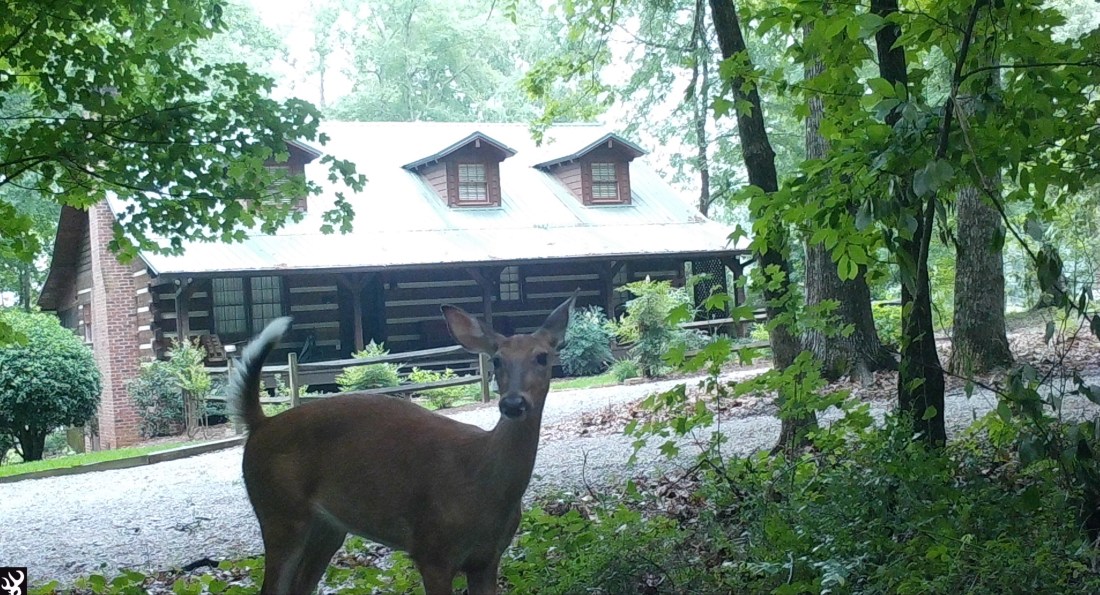
The field camera had been set to snap four pictures of any movement around the circle driveway – one picture every two seconds for eight seconds.  More than 400 photos were waiting for review.  Not surprisingly, the first pictures showed a doe keeping watch over The Cabin (picture above).  The movement of deer is predictable – early morning and a couple hours after nightfall.  Could set your clock by it.  They know they are safe near The Cabin.

The fox was not as predictable but always quick.  The camera was lucky to get two pictures in the allotted eight seconds and usually could get only one as the fox could scoot by in less than two seconds.  Raccoons showed their striped tails forever, and squirrels practically posed for multiple snaps.  Stray dogs, we know who you are.

The pest control guy unknowingly hogged a lot of camera time, and workers next door found it easier to use our driveway, which was fine.  The Petitt gang hammed it up a couple of times for the camera while cutting, edging and blowing the grass.  Brett and Bradley usually locate the camera while taking care of the property.  I cannot show their Dad all of their shenanigans.  The camera doesn’t miss much of anything.

The screened porch on the other side of The Cabin, the lake side, was covered with pollen, the screens seeming to sift that awful stuff into an even finer layer of mess. Hose and mop time for that porch, the rocking chairs and every nick nack neatly placed by my WW.  Probably would take half a day to get the screened porch right for the next morning’s cup of coffee.

But nothing at The Cabin is a chore. Blowing off the driveway and hosing down the long walkway, no problem.  Clearing fallen limbs from a recent storm, no problem.  Plugging carpenter bee holes, no problem. Hauling wood for the fire pit, no problem. Putting on two racks of baby back ribs … are you kidding?

Good to be back.


A Ton Of Fun …

57E81043-EBA4-42DF-A9C7-45D07D53873D

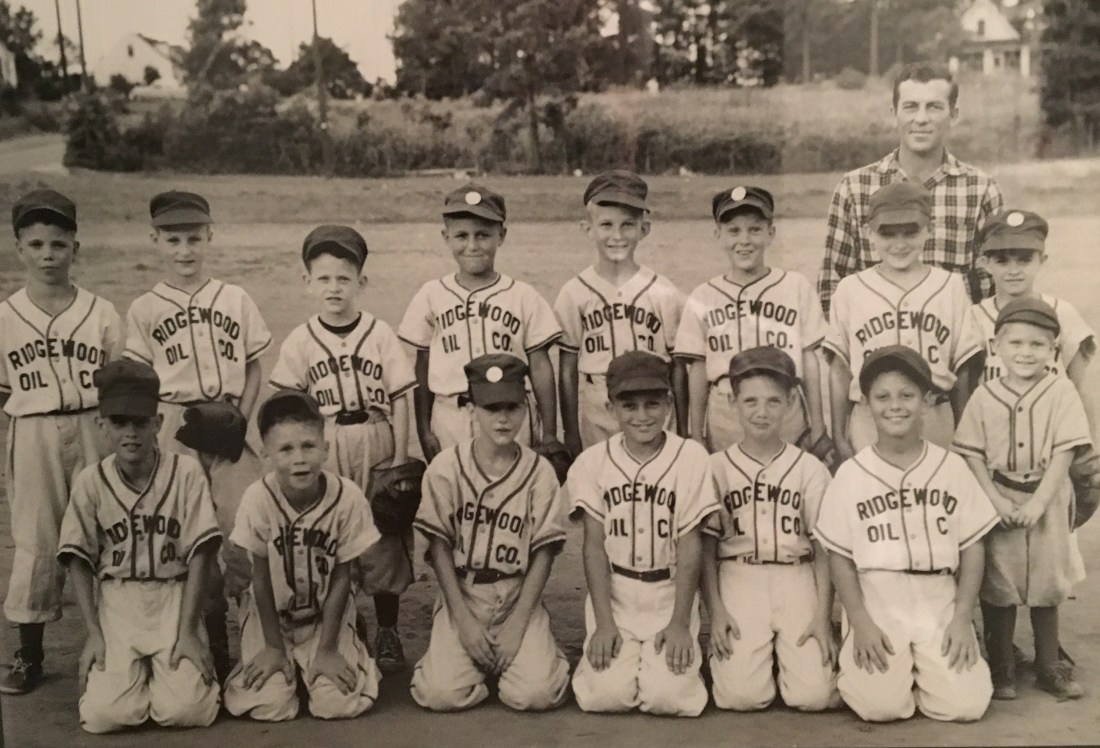
We weren’t very good.  But we had a ton of fun. You can look at the picture above and probably figure that out.

Ridgewood Oil Co. was my first baseball team. At least, it was the first team that was truly organized with uniforms and in a league.  I often tried to put together a sandlot game with neighborhood friends, but we could not always find a bat or ball or yard big enough to mark off the bases.  And, finding the bases themselves could be a challenge – we’d use a rock or hat or somebody would volunteer their shoes and play barefooted.

But we didn’t have to worry about any of that when we played for Ridgewood Oil. The field was just off Westwood Drive on the grounds of Heyward Gibbes School. The bases were real.  Home plate was real. Real umpires.  The base paths were straight and marked neatly with chalk.  On game day, we had died and gone to baseball heaven.  Didn’t matter that most likely we would lose to another team in our league.

Our uniforms were treasures although you might never know it from the picture above.  Some guys might have to borrow a teammate’s hat or glove on game day, but nobody ever misplaced their Ridgewood Oil Co. shirt – unless at the end of the season when all equipment and uniforms had to be turned in. Guys thought it was a badge of honor to be caught wearing a team shirt weeks after the season.

The land behind the photo above eventually became a street with several new homes.  A friend for many years, Fred Best, and his parents and two older sisters moved into one of those new homes and was the envy of many of us.  Fred had a pretty house, pretty yard and … pretty sisters.  The field we played on did not have an outfield fence.  That meant you could run forever if you could hit the ball between the outfielders and toward Fred’s house.

While a lot of those days and facts in the 1950’s with Ridgewood Oil are a blur, lots of  memories are distinct.  Especially memories of teammates.  While I could use some help identifying several in the picture above, I do remember most of the guys.

Back row, first on the left, is Skip Clark, probably the best player on the team.  Good glove, good arm, good hit, as coaches would say.  Next to him is Heyward Sutherland, our best pitcher whose Dad just might have owned Ridgewood Oil (a blur).  Then there is Jerry Cannon, the smallest player on the team who lived just up our street on Margrave for a while.  Next to Jerry is Donnie Jeffcoat, one of the best catchers ever – youth ball and otherwise – in the Eau Claire area.  Mostly because of the position he played, Donnie stayed dirty a lot.  Donnie’s brother Jerry is kneeling on the front row, fourth from the left.  Jerry, probably the fastest runner on the team with the strongest arm and a close friend in our teenage years, sadly passed away last year.

Standing next to Donnie is Kerry Brown, a year younger than me who lived on Myles Avenue.  His sister Donna was in my class or maybe a year behind me.  That’s me next to Kerry with the goofy look on my face – good glove, fair arm, no hit, as the coaches would say.  Alvin Loupe is last on the right.  Alvin was slightly taller than our bat boy, quick and always had tons of energy.  Seems like his mouth ran a lot, too.

That’s Larry Dodd, kneeling second from the left.  Larry and Skip were our best players, and I recall that Larry could knock the cover off the ball.  Often he would keep running after hitting the ball toward Fred’s house even though our base running coaches would holler for him to stop.  The bat boy is my brother Harry, and the coach is my Dad.  Harry didn’t really have much to do.  He was along mostly for the ice cream cone after the games.

While I cannot recall names of the other teammates, I do remember that a couple of them were real rascals who would just as soon be elsewhere on game day.  Probably lawyers or politicians or incarcerated today.

Game day for Ridgewood Oil Co. was always special.  No worries about homework or chores – things required of kids back then.  And, despite only one car per family in most cases, players generally were at the field on time.  A lot of them, like me, walked a mile or two to the field and arrived in plenty of time.  My Dad usually came straight from work to the field with the equipment bag in his trunk.  The big stress came if the equipment bag was late; everybody used one of only two or three bats in the bag.  Nobody toted their own personal bags with personal helmet, personal batting gloves, personal water bottle and a couple of personal bats.  Are you kidding?  We never knew what we didn’t have.

But we had a ton of fun.  If you doubt it, just take another look at that picture above.


People and Places …

3C6A9A89-759C-47C4-AEFE-D5AD1A3F6EE8

Some places are just downright unforgettable.  Kinda like some people.

Our Viking riverboat cruise lived up to its billing.  We visited The Netherlands, Germany, Austria and Hungary.  Saw castles, cathedrals and palaces everyday.  The vineyards outnumbered the glasses of wine we enjoyed, and that’s saying a lot.

We visited Amsterdam’s Keukenhof Gardens that boasts of six million tulips.  I think we saw all of them, but I stopped counting just short of a hundred.  Each castle had its own story, each cathedral its own brilliance and each palace its own family history.  And, I didn’t see a single creaky screen door on any of those palaces.

The sites were plentiful and breathtaking.  But these trips are as much about the people as the places.  Our riverboat, the Viking Baldur, had rooms to accommodate about 180 of us.  Excuse me, staterooms for 180 of us.  And, with three unnecessarily lavish meals each day there was plenty of time to eat and meet.  Mature adults, i.e. old folks, i.e. us, tend to get clique-ish, especially during a 17-day ride.  So, our clique formed quickly with some interesting characters.

Mack, from New Mexico who likes to be called a portion of his last name, is the type guy who could be a friend for life.  His real name is Gary and he livens every conversation with a subtle quip that brings belly laughs.  A former rugby toughie, he kept studying in life and earned four undergraduate degrees.  Sticking a ring on Cathy’s finger 25 years ago was his best accomplishment, and being part of their 25th anniversary on the riverboat was special.  Knew Mack half the cruise before learning he had polio as a child and wore those Forest Gump leg braces.  No need to dwell on any of that.  “Always better to look forward than backward,” he says.  Quality guy; quality wife.

James and Lynn have been married twice as long as Mack and Cathy.  From Arkansas, this couple is celebrating 50 years of marriage by tripping to several places around the world.  Either could have stepped off the pages of a fashion magazine, but Lynn was not shy about wearing the anniversary gift from new riverboat friends – plastic, gaudy, pierced diamond earrings. We worried her ear lobes might turn green after the third day.  This couple fit right in.

John and Marcia, from California, found a place at our table most meals, too.  I had to prod John to remove his blue LA Dodgers hat a couple of times.  His response: “Do you guys play major league baseball in Atlanta?”  They fit right in, too.

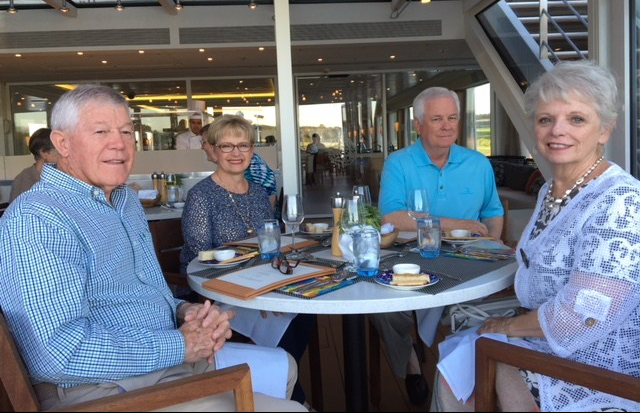
Leaders of the pack were the Brewers, our traveling partners and S.C. friends forever (pictured above).  Buddy, who uses “awesome” to describe everything, probably met 179 of the 180 passengers.  Wife Lynn could teach the Viking cruise managers and tour guides a thing or two.  As a couple, the Brewers are … well, awesome.

Outside our clique were other interesting people.  There was the gregarious businesswoman executive from Pennsylvania who previously had been a nun for 25 years.  And the beef and hay manufacturer from Utah.  And the nice couple who recently had moved from Hawaii to Georgia and now live in Marietta – just a short distance from our home in Woodstock.  We went half way around the world to meet these neighbors.

There were others, too, but by far the most interesting couple we met on board was Leonard and Mary Ann, from Oregon.  Leonard, a lawyer, has authored 30-plus books and presently is busy on nine revisions.  Supreme Court Justice Ruth Bader Ginsburg penned a forward for one of his books as did several other notables.  Leonard and Mary Ann have been on 32 cruises since 2002, and they schedule two every year despite working full-time.  They met in 1964 and have been married 52 years.  But they do not talk about 1964.  Leonard is blind, and 1964 is when he lost part of his left arm, fingers on his right hand and his eyesight.  When he was brought to the hospital, Mary Ann was his nurse who promised to stay by his side during his recovery.  She has been his eyes ever since.  He has never seen her.  And that’s all they have to say about that.

Kinda like Mack said, always better to look forward than backward.  Even if you cannot see.

For 17 days, Leonard and Mary Ann trudged through castles, gazed at sky-high cathedrals and visited ornate mansions with gold walls and meticulously detailed ceilings and artwork.  And, he is blind.  With his right hand seemingly attached to her shoulder, she continuously and quietly described details for him to envision.  Whether through windows on a bus ride or from the top deck of the Baldur, Mary Ann was Leonard’s eyes with a patient description for everything.  How amazing.

At breakfast one morning, Leonard talked about the cabin they own on a river in Oregon.  He described details of each room, confirmed by Mary Ann’s photos, even though he has never seen the cabin.  We swapped cabin stories and agreed that we should plan trips to visit each other – at our cabins.  Such a special, inspiring couple.

The Viking cruise concluded in Budapest, one of the world’s most photographed cities.  A night cruise along the Danube produced spectacular views of the city, sites that are downright unforgettable.

Kinda like the people.


Paul and Pope Davis …

I always knew Paul would do well.

My first team as a youth baseball coach was Pope Davis, named after a tire company in West Columbia (S.C.).  The team had a reputation for not winning.  As I recall, rules in the Pineview league required players to stay on the same team each year until their age prompted a move up to the next league.  Well, Pope Davis had not won a game in two years, maybe three.  Opposing teams liked to play the Pope Davis team I inherited.

Odd, but I can recall names of the five- and six-year-olds on that first team.  Brian at first, Kevin at second, Dalton at shortstop, Phillip at third, John in left field, Torrey in center, Michael in right, Scott behind home plate and Samantha on the mound. But, where was Paul?  The lineup of nine left no position for Paul at the start of the season. He was our first sub.

We emphasized fundamentals the first year.  My theory has always been that no kid ever allows a grounder to go through his legs intentionally, so there’s never a reason to yell after an error.  The kid already feels bad enough; just teach him fundamentals so it might not happen the next time.  On the other hand, nothing wrong with a polite holler to Torrey in centerfield who is trying to catch a grasshopper or to John in left field who is mesmerized by a plane in the sky.  Both true.

So, fundamentals helped Pope Davis win a game the first season, several the second season and – get this – go 16-0 the third season. That’s the year nobody wanted to play Pope Davis.  But, what about Paul?

While Paul was not a starter in his first game for Pope Davis, it was obvious that he was a smart kid – very smart – who always had an enthusiastic attitude, a zest for the game, and a smile.  He could not run very fast, probably the slowest on the team, but nobody out-hustled him and nobody improved faster.  And, he learned to hit the proverbial cover off the ball.

Paul became a starter after just a couple of games.  He first mastered the outfield, then third and second base and then shortstop.  Before the first season ended, he could play any position.  Coaches did the pitching or he probably could have done that as well.  More on that later.  He was picked as an All-Star at the end of the second and third seasons.

The Pope Davis experience was one of those worst-to-first tales.  That’s probably why the names and memories are still fresh after 37 years.  Pretty sure Samantha was the first girl to play in the league; Torrey was probably the first black player, and his brother Kelsey joined us the second year; Scott walked into a swinging bat at practice, lost his front teeth and spent the evening at the emergency room.  My most vivid memory: an outfielder at practice would not come off the field so I went out to get him only to hear “coach, I pooped in my pants.”  I have never summoned a mother to the field so fast.

Shortly after the Pope Davis days, we moved to the Atlanta area and lost touch with most of our West Columbia area players and their parents.  But, the memories of that first team still surface.  And, what about Paul?

Paul went on to be an outstanding player at Lexington High School before playing one year at Clemson University as a pitcher (1.50 earned run average) and then three seasons at Vanderbilt University where he won 14 games as a starting pitcher.  It did not end there.  He was a pitcher in the Boston Red Sox organization where he played for the Gulf Coast Red Sox team as a relief pitcher in 130 games.  He recorded 196 strikeouts in 220 innings pitched.  Not bad for a slow-footed kid who did not start for a winless Pope Davis team as a six-year-old.

But, it doesn’t end there for Paul either.  If you Google the name Paul Seybt, you will find M.D. after his name.  He’s with a group of doctors who provide pathology services at Lexington Medical Center.  Dr. Paul Seybt is the one with the smile.

I always knew Paul would do well.


Hero In Houston …

Thirteen years ago, my WW (Wonderful Wife) and I were sitting at a table in the dining hall at MD Anderson Cancer Center in Houston.  We were agonizing as we awaited more results of biopsies of a tumor – already diagnosed in Atlanta as malignant – in my neck.  We had met Dr. Chris Holsinger a day earlier.  I remember wondering if he had started shaving yet.

My WW and I obviously looked distressed as we picked at our salads.  Into the dining hall walked a group of doctors including Dr. Holsinger.  He caught our worried looks, left his group and pulled up a chair at our table.

“You look worried,” he said.  “Let me assure you of something.  There is nothing we will encounter that we won’t have a plan for.  Nothing.”  He stayed with us for quite a while, encouraging us to eat but understanding why we couldn’t.  We learned about his family and he learned about ours.  Then he bopped up and off he went to save lives.

We did not get good news the next day but somehow felt better about facing our challenge with Dr. Holsinger in charge.  As we approached surgery, we met several times with him.  A couple of things stood out: he was always upbeat, cheerful and optimistic, and he always had a hug for my WW.  Always.

During one of our conversations, I told him I was planning to write a book some day. “If you get me through this tumor thing, you might get a mention in my book,” I told him with a smile.  He was amused and often asked me in subsequent visits if I had started my book.  “Well, I’m still kickin’ which means you’re still doing a pretty good job … so far.  You keep this up and you might move up from a mention to your own sentence, maybe even a paragraph.”

I appreciated Dr. Holsinger so much I decided to write a letter of thanks to him a few months after the surgery. Then I changed my mind and decided to write a letter to his wife.  I told her how much my WW and I appreciated her husband, not just his surgical and medical skills but also – mostly – his caring, sincere manner. I told her she was fortunate to have him as a husband.  Dr. Holsinger later thanked me for sending the letter and, typically, said he put it on a coffee table in their house in plain view for several days so his wife would not forget the part about how fortunate she is to have him.  So it was with this talented but obviously down-to-earth surgeon.

Follow-up visits to Houston became follow-up visits to Palo Alto, California after Dr. Holsinger accepted an offer to become Professor and Chief of Head and Neck Surgery at Stanford University Medical Center.  Not surprising at all to us.  In not-so-medical terms, he knows his stuff.  Our choice was either to stay with M.D. Anderson in Houston or go with Dr. Holsinger to California for on-going scans.  Easy decision.  After all, he had started shaving by then.

And, last year – after nine years of trips to Houston and three more years of trips to Palo Alto – Dr. Holsinger told us, in so many words, that since I’m still kickin’ after 12 years, there’s no reason for us to keep meeting like this.  We were happy to be released but obviously sad to say farewell.  His last act with us was a hug for my WW.

And, that possible mention in my book?  Dr. Holsinger had gone from a mention to a sentence to a paragraph to his own chapter.  A blog is the least I can do for a hero.